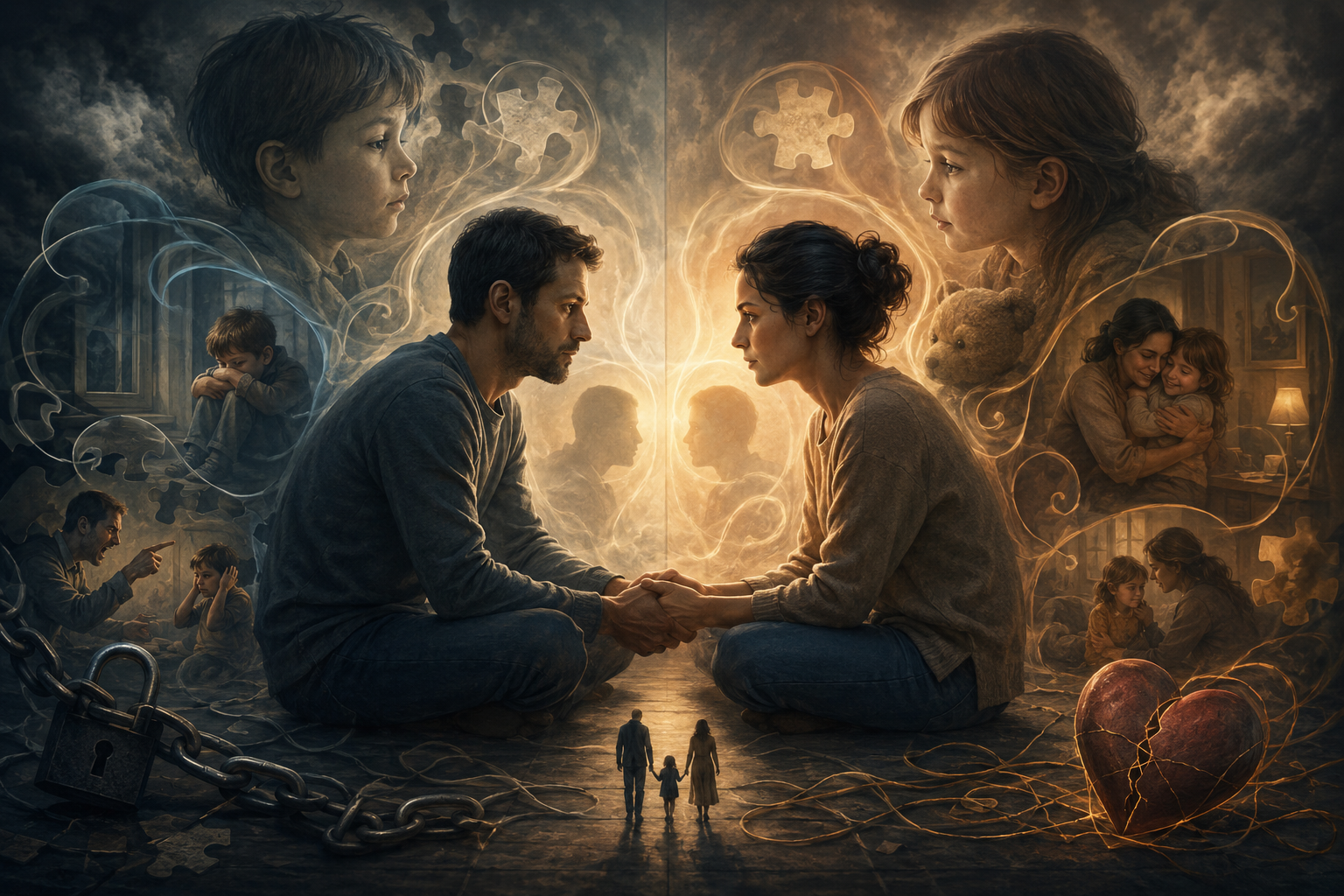
Divorce is often explained in everyday terms — poor communication, incompatibility, growing apart. But psychoanalysis, the school of psychology founded by Sigmund Freud and expanded by later theorists such as Melanie Klein, Donald Winnicott, and John Bowlby, looks beneath these surface explanations. It asks a deeper question: what unconscious forces, formed in early childhood, are silently shaping the way two adults relate to each other in marriage?
From a psychoanalytic point of view, a marriage is never just a relationship between two adults. It is also, unconsciously, a meeting between two childhoods.
The Unconscious Blueprint Formed in Early Childhood
Psychoanalytic theory holds that our earliest relationships — particularly with our parents or primary caregivers — form internal templates, known as internal object relations, that continue to operate throughout adult life, largely outside our conscious awareness.
A child who experienced a caregiver as inconsistent, critical, or emotionally unavailable internalizes a certain image of "how relationships work." A child raised by a warm, attuned, and emotionally available caregiver internalizes a very different one. These internalized images do not remain in the past — they are carried forward and unconsciously projected onto our adult partners.
This means that when two people from different family environments marry, they are not simply combining two personalities. They are bringing together two unconscious relational worlds, each built from a different set of early experiences, expectations, anxieties, and defenses.
Transference: Marrying the Parent We Never Resolved
One of psychoanalysis's central concepts is transference — the unconscious redirection of feelings and expectations from an early relationship (usually with a parent) onto a present relationship.
In marriage, transference is remarkably common. A partner may unconsciously expect their spouse to provide the emotional attunement their mother never gave them, or may react with disproportionate anger to a minor comment because it unconsciously echoes a critical father. The spouse, in turn, is often not reacting to who their partner actually is in that moment, but to an unconscious image from childhood being projected onto them.
This is why conflicts in marriage can feel so intense and irrational in the moment — the couple is not only arguing as two adults, but is also, unconsciously, replaying old and unresolved childhood dynamics through each other.
Repetition Compulsion: Recreating the Familiar, Even When It Hurts
Freud described a phenomenon called repetition compulsion — the unconscious tendency to recreate familiar emotional patterns from childhood, even painful ones, because they feel psychologically familiar and, in a strange way, "safe."
A person raised in a home marked by emotional distance may unconsciously choose a partner who is also emotionally distant, or may unconsciously provoke distance in an otherwise available partner — not because they want to suffer, but because the unconscious mind gravitates toward what it already knows, even when what it knows is painful.
Over the years of marriage, this repetition can quietly recreate the very childhood dynamics each partner was hoping to escape — leading to conflict, disappointment, and eventually, for many couples, divorce.
Defense Mechanisms: Protecting the Self at the Cost of the Relationship
As differences and unconscious conflicts surface in marriage, partners often rely on defense mechanisms developed in childhood to protect themselves from emotional pain. Common defenses seen in marital conflict include:
- Projection — attributing one's own unacceptable feelings (anger, insecurity, jealousy) onto the partner, rather than owning them.
- Denial — refusing to acknowledge a growing problem in the relationship.
- Splitting — viewing the partner in all-or-nothing terms, as either entirely loving or entirely the enemy, with little middle ground.
- Withdrawal/repression — pushing difficult feelings out of conscious awareness, only for them to resurface later as resentment or emotional numbness.
These defenses, while protective for the individual in the short term, prevent real intimacy and honest resolution of conflict — slowly eroding the emotional foundation of the marriage.
The Return of the Repressed
Freud proposed that whatever is repressed in the unconscious does not disappear — it returns, often in disguised or symbolic form. In marriage, this can appear as:
- Sudden, seemingly disproportionate anger over small issues (household chores, tone of voice)
- Recurring arguments that never seem to resolve, despite being "about" different topics each time
- A persistent, hard-to-name feeling of dissatisfaction, even when the relationship looks fine on the surface
These are often signs that older, unresolved childhood material is resurfacing through the marital relationship rather than being addressed directly.
Why Divorce Often Feels Inevitable — and Why It Isn't
From this lens, divorce frequently results not from incompatibility in the ordinary sense, but from two unconscious worlds colliding without either partner having the insight to recognize what is happening. Each partner experiences the conflict as being entirely about the other person, when in fact, much of it is being generated internally — from unresolved childhood experiences being replayed in the present.
This does not mean couples are doomed by their histories. Psychoanalytic therapy — and psychodynamically informed couples counselling — works precisely by helping each partner:
- Recognize their own internal object relations and where they originated
- Identify transference reactions as they occur, rather than acting on them blindly
- Understand repetition compulsion patterns that may be quietly damaging the relationship
- Develop healthier, more conscious ways of relating, rather than relying on childhood defenses
Final Thoughts
Psychoanalysis reminds us that a marriage is rarely just a relationship between two adults in the present moment. It is also, quietly and unconsciously, a meeting of two childhoods, two sets of unresolved longings, and two internal worlds shaped long before the couple ever met. When these unconscious dynamics go unexamined, they can generate conflict that feels impossible to resolve — often ending in separation or divorce.
However, with insight-oriented psychological support, couples can begin to separate the past from the present, recognize what truly belongs to their history versus their current relationship, and build a marriage based on conscious understanding rather than unconscious repetition.
If you and your partner are experiencing recurring, hard-to-resolve conflict, psychodynamic couples counselling can help uncover the deeper patterns at play. Our team of experienced psychologists offers confidential, professional support to help couples build healthier, more conscious relationships.