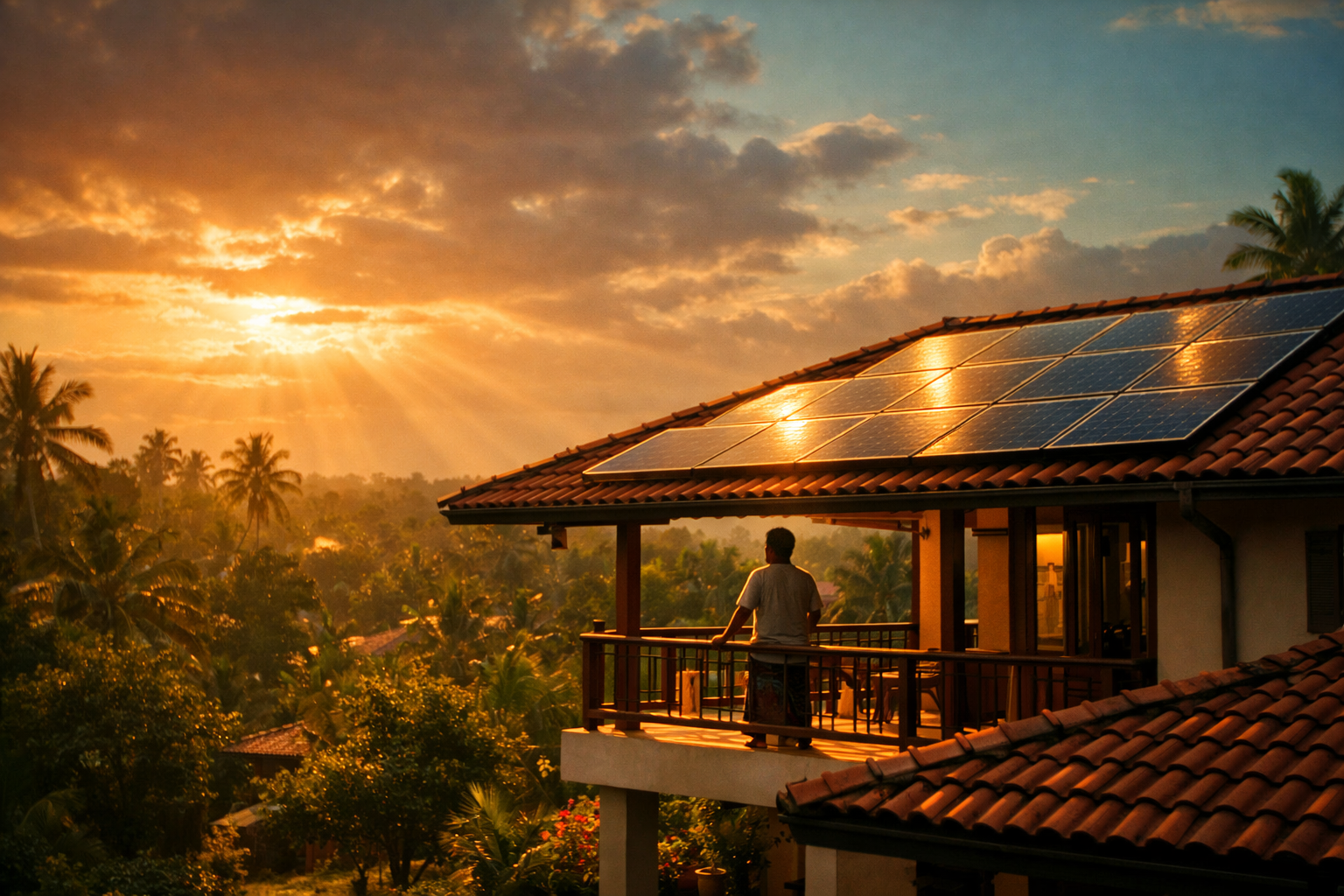
Mental Wellness · Solar Energy · Sri Lanka | Persona Mind | 10 min read
You wake up, scroll the news, and before your coffee is done, you've read about another heatwave, a species extinction, and a glacier retreat. A low, heavy feeling settles in your chest. By the time you leave for work, you already feel tired — not from sleep deprivation, but from something harder to name.
That feeling has a name now: eco-anxiety. And you're far from alone in feeling it.
The American Psychological Association defines eco-anxiety as the chronic fear of environmental doom — a persistent, often debilitating sense of dread about the state of the planet and humanity's future on it. Unlike a specific phobia with a clear trigger and endpoint, eco-anxiety is diffuse and relentless, fed by real events unfolding in real time across every screen in your life.
This article explores the psychology behind it, why it's especially pronounced in Sri Lanka and across South Asia, and — most importantly — how taking a single, tangible action like installing solar power can begin to genuinely shift your mental state from helplessness to agency.
What Eco-Anxiety Actually Feels Like
Eco-anxiety isn't always dramatic. It rarely looks like a panic attack. More often, it shows up as a background noise — a low-frequency hum of unease that colours everything without announcing itself.
Common symptoms include persistent worry and rumination — intrusive thoughts about climate outcomes like floods, droughts, and food shortages that return even when you consciously try to redirect attention. The brain treats abstract existential threats similarly to immediate physical ones.
Sleep disruption is another hallmark. Climate-related anxiety activates the hypothalamic-pituitary-adrenal (HPA) axis — the body's stress response system. Elevated cortisol makes it difficult to fall or stay asleep, creating a fatigue loop that worsens emotional regulation over time.
Many people also experience irritability and emotional numbness. When the nervous system is chronically stimulated by climate dread, people often vacillate between emotional flooding — anger, grief, overwhelm — and protective numbness, a psychological shutdown designed to avoid feeling too much at once.
Perhaps the most psychologically corrosive symptom is a paralysing sense of powerlessness. "What difference does one person make?" is not really a question — it's a conclusion that breeds learned helplessness, the belief that one's actions are fundamentally disconnected from outcomes.
A landmark 2021 study published in The Lancet Planetary Health surveyed 10,000 young people across ten countries. The findings were striking: 59% said they felt very or extremely worried about climate change. Nearly half said their feelings about the climate negatively affected their daily functioning. This wasn't niche environmentalist anxiety — it was mainstream psychological distress.
Eco-Anxiety in Sri Lanka: A Compound Crisis
In Sri Lanka, eco-anxiety doesn't exist in isolation. It intersects with a lived experience of energy insecurity that makes climate dread feel immediate and personal rather than abstract and distant.
Between 2021 and 2023, Sri Lanka experienced some of its worst economic turbulence in modern history. The energy crisis — characterised by prolonged power cuts sometimes stretching 12 hours a day, soaring fuel prices, and unreliable grid supply — turned electricity into an anxiety trigger of its own. Families budgeted meals around when the power would be on. Businesses planned operations around grid schedules. Students studied by candlelight.
For many Sri Lankans, this wasn't theoretical climate anxiety. It was climate-adjacent financial and logistical stress, arriving in real time at the household level. The psychological toll was — and continues to be — significant.
Sri Lanka also receives among the highest average solar irradiance in South Asia — approximately 5.5 kWh per square metre per day. The country has a stated national goal of achieving 70% renewable energy by 2030. For households, this creates a rare alignment: solar adoption is both personally beneficial and nationally meaningful — a double source of psychological reward.
When people feel that the forces causing their stress are too large, too distant, or too abstract to address, the natural psychological response is avoidance. News consumption drops. Civic engagement falls. Apathy sets in — not because people stop caring, but because caring without agency is unbearable.
This is why the psychological solution to eco-anxiety isn't better coping strategies for helplessness. It's the restoration of agency itself.
The Psychology of Action: Why Solar Is Different
There's a meaningful difference between eco-anxiety management techniques — mindfulness, news detoxes, therapy — and eco-anxiety resolution. The former helps you live with the feeling. The latter addresses its root: the gap between caring and acting.
Behavioural psychology has long understood that self-efficacy — the belief that your individual actions can produce meaningful outcomes — is one of the most powerful psychological buffers against anxiety and depression. When people take deliberate action aligned with their values, the nervous system responds differently than when they merely worry.
Solar energy adoption is, in this context, unusually well-positioned as a psychological intervention. Unlike switching to reusable bags or adjusting your thermostat, solar is a structural change. It doesn't require daily willpower or repeated decisions. Once installed, it silently generates clean energy, reduces bills, and keeps demonstrating that the choice was right — day after sunrise.
Three Deep Psychological Shifts That Solar Triggers
1. Empowerment and the Restoration of Self-Efficacy
Albert Bandura's theory of self-efficacy holds that our belief in our ability to influence outcomes is central to motivation, resilience, and mental health. When self-efficacy is low — as it is in chronic helplessness — anxiety, depression, and avoidance tend to follow. When self-efficacy is restored, people become more active, more optimistic, and more resilient under stress.
Installing solar panels is one of the highest-self-efficacy actions available to a private individual on the topic of climate change. You're not signing a petition or changing a habit — you're physically restructuring how your home relates to the energy grid. The panels on your roof are visible, tangible evidence that you have chosen a different relationship with fossil fuels.
Research on pro-environmental behaviours consistently shows that people who take high-impact climate actions report lower eco-anxiety — not because the climate crisis is solved, but because their internal narrative has shifted from "I am powerless" to "I am part of the solution." That shift is psychologically transformative.
2. Moral Satisfaction and the "Warm Glow" Effect
Economists and psychologists alike have documented a phenomenon known as the warm glow effect: the positive emotional experience that accompanies prosocial or altruistic behaviour. When we act in alignment with our values — particularly when those actions benefit others or the broader world — the brain's reward system releases dopamine, creating a genuine sense of satisfaction that is distinct from hedonic pleasure.
This isn't a metaphor. Neuroimaging studies have identified activation in the ventromedial prefrontal cortex and nucleus accumbens — areas associated with reward and satisfaction — when people engage in acts they perceive as morally meaningful.
For people experiencing eco-anxiety, this matters enormously. The anxiety is in large part a symptom of values-action misalignment: you care deeply about the environment, but your daily life doesn't yet reflect that care in a tangible way. Solar adoption closes that gap. It converts the emotional weight of caring into the lightness of doing — and the brain registers the difference.
Studies on renewable energy adoption also highlight the role of social norms and identity. When people install solar, they become visible members of a community of action. This sense of social belonging and shared purpose further amplifies the psychological reward, particularly in communities where solar adoption is growing — as it is across Sri Lanka.
3. Reduced Financial Stress and Cortisol Relief
The relationship between financial stress and mental health is well-established. Chronic financial worry activates the same HPA-axis stress response as physical threats, elevating cortisol levels and suppressing the prefrontal cortex — the part of the brain responsible for calm, clear-headed thinking.
In Sri Lanka, electricity bills and fuel costs have been a consistent source of household financial anxiety. Unpredictable billing, tariff increases, and power instability make energy one of the most stress-inducing line items in a household budget.
Solar changes this calculus fundamentally. After the initial installation, solar households typically see electricity costs drop by 60–80%. The grid becomes a backup rather than a dependency. Financial uncertainty around energy — one of the most basic necessities of modern life — is dramatically reduced.
Lower chronic financial stress means lower baseline cortisol. Lower cortisol means better sleep quality, improved emotional regulation, sharper cognitive function, and greater capacity for joy. These are not small effects. Chronic cortisol elevation is associated with serious long-term mental and physical health consequences; its reduction is correspondingly significant.
From Helplessness to Hope: The Internal Journey
It's worth being precise about what solar adoption does and doesn't do for eco-anxiety. It doesn't make climate change less real. It doesn't neutralise the grief of environmental loss or eliminate the legitimate concern about large-scale systemic failures. No single household action can do that, and pretending otherwise would be dishonest.
What solar does do is interrupt the helplessness loop.
Eco-anxiety feeds on the perception that the problem is too large, the forces too powerful, and the individual too small. That narrative — however understandable — is corrosive. It immobilises rather than activates. It converts caring into suffering.
When you install solar, you make a different bet. You bet that your choices matter. You bet that the accumulation of individual, structural decisions is how systems actually change. And then — crucially — you get daily, material evidence that you were right. The meter runs backwards. The bill shrinks. The roof works while you sleep.
Psychology calls this behavioural activation: the process by which taking positive action builds motivation, mood, and momentum for further action. People who install solar often report that it doesn't just reduce their eco-anxiety about energy — it makes them more likely to take other meaningful actions, because the internal narrative has shifted from "I can't" to "I can."
That ripple effect — from one structural household decision to a broader reorientation toward agency and hope — may be one of solar's most underrated benefits.
A Practical Note for Sri Lankan Households
Sri Lanka's solar potential is genuinely exceptional. With average solar irradiance of around 5.5 kWh/m² per day, the country captures more usable sunlight than much of Europe. Feed-in tariff programmes allow households to sell excess electricity back to the grid. Government subsidies and low-interest financing options have made solar more accessible than ever.
The practical and psychological cases for solar adoption in Sri Lanka align unusually well. This is a country where the energy problem is visible, where the solar solution is technically strong, and where the mental health costs of energy insecurity have been deeply felt in recent years.
You don't need to wait for governments to act before your household begins its transition. The technology is mature, the economics are increasingly favourable, and the psychological benefits begin the day the panels go up — or perhaps even earlier, when the decision is made.
Conclusion: Caring Is Not Enough — Acting Is
Eco-anxiety is real, it is valid, and it is, in many ways, a reasonable response to the climate reality we inhabit. The research is clear: younger generations in particular are carrying a psychological burden that previous generations simply didn't face.
But caring — even deeply, even painfully — is not the same as acting. And in the gap between caring and acting, anxiety thrives.
Solar power offers something that no amount of mindful news consumption, green consumer choices, or climate grief circles quite can: a structural, durable, daily-reinforced demonstration that you have chosen agency over passivity, solution over paralysis, hope over despair.