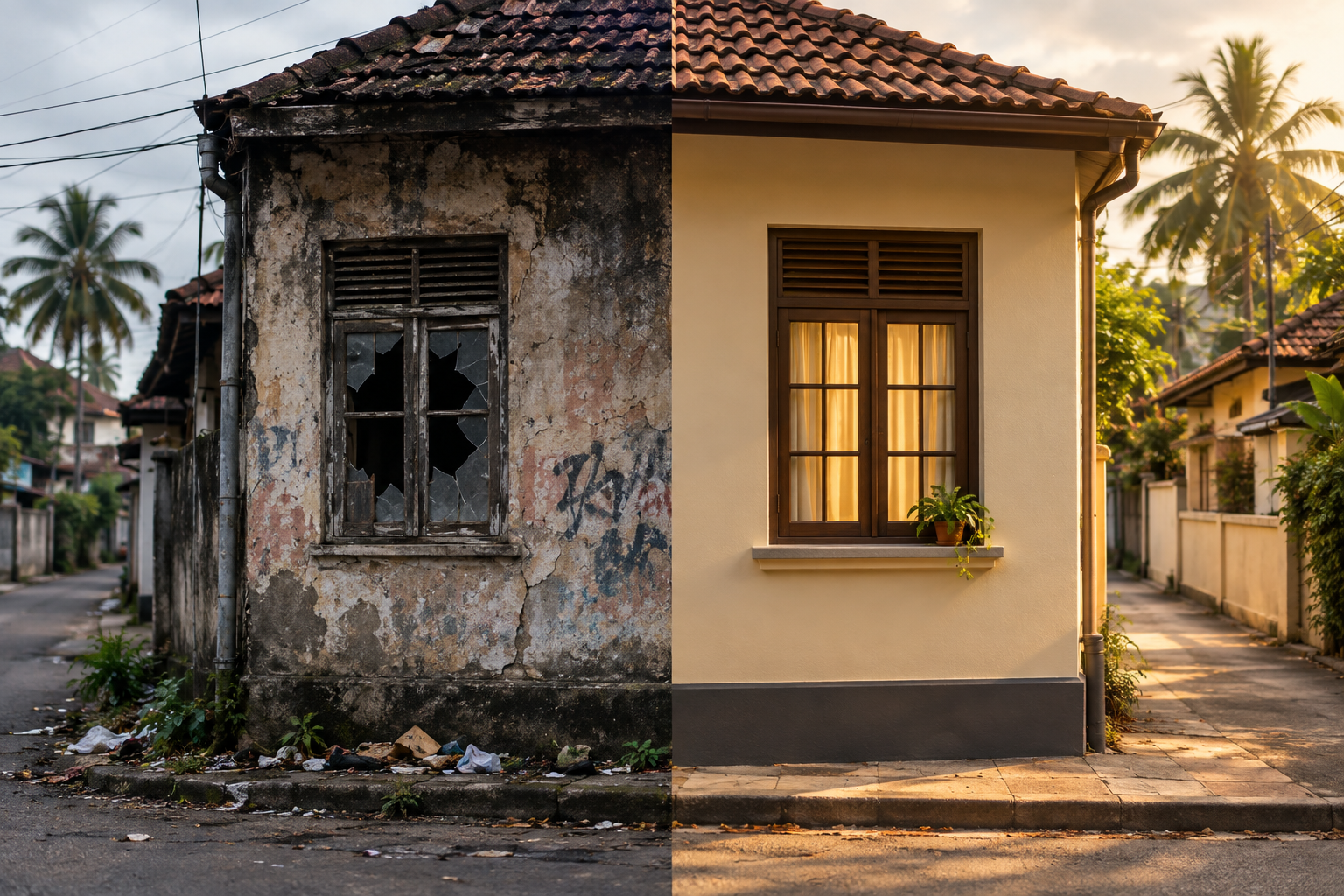
If you have walked through a neighbourhood in Colombo, Kandy, or Galle where garbage has piled up uncollected, walls are covered in graffiti, or a building has stood half-finished and abandoned for years, you may have noticed something curious: these areas often seem to accumulate more disorder over time. More litter appears. More minor rule-breaking happens. The area starts to feel unsafe, even if nothing dramatic has occurred there. This everyday observation is at the heart of one of the most influential — and most debated — ideas in social psychology and criminology: the Broken Window Theory.
Where the Theory Came From
The theory was introduced in 1982 by social scientists James Q. Wilson and George L. Kelling in an article published in The Atlantic. Their central argument was simple: visible signs of disorder and neglect in an environment — a broken window left unrepaired, litter left uncollected, graffiti left unpainted — send a signal. That signal is not just "this place is untidy." It communicates something psychologically powerful: nobody is watching, nobody cares, and the normal rules here are weaker than you think.
Wilson and Kelling drew on earlier work by psychologist Philip Zimbardo, who in 1969 ran a now-famous field experiment. He left two cars abandoned — one in a rundown area of the Bronx, New York, and one in a more affluent neighbourhood in Palo Alto, California. The Bronx car was stripped and vandalised within hours. The Palo Alto car sat untouched for over a week — until Zimbardo himself smashed one of its windows with a sledgehammer. After that single act of visible damage, passers-by began vandalising the car too, within a matter of hours. The lesson: it wasn't poverty or social class that triggered the vandalism. It was the presence of a single, visible cue that disorder was already tolerated.
The Psychology Behind the Broken Window
As a psychologist, what interests me most about this theory is not the criminology or urban policy debate that followed it, but the underlying human mechanisms it reveals. A few concepts help explain why a broken window has such disproportionate power.
Descriptive social norms. Psychologist Robert Cialdini's research on social norms shows that people are strongly influenced by what they believe others are doing, not just by formal rules. A clean, well-kept street communicates an implicit norm: "people here don't litter." A street full of rubbish communicates the opposite norm just as clearly — and people calibrate their own behaviour to match what they perceive as normal, even unconsciously.
Diffusion of responsibility. When an environment already shows neglect, individuals feel less personally responsible for maintaining it. If everyone believes the mess is "not my problem to fix," small infractions accumulate because no one feels ownership over correcting them.
Deindividuation. Neglected, poorly lit, or chaotic environments can reduce a person's sense of individual accountability. When people feel anonymous or unobserved, self-regulation weakens — a well-documented effect in crowd and environmental psychology.
Environmental cues and priming. Environmental psychology research consistently shows that physical surroundings act as behavioural primes. A clean, orderly space cues carefulness and conformity. A disorderly one cues carelessness and rule-breaking. The environment is not a passive backdrop to behaviour — it actively shapes it.
Put together, these mechanisms suggest that disorder is not just a symptom of a struggling community — it can also be a cause of further disorder, through a psychological feedback loop.
The Controversial Real-World Application
Wilson and Kelling's ideas were famously adopted by New York City's police department in the 1990s, most closely associated with Commissioner William Bratton, who implemented aggressive enforcement of minor offences (fare evasion, public drinking, vandalism) on the theory that cracking down on small infractions would prevent larger crimes. Crime rates in New York did fall substantially during this period, and "broken windows policing" was credited by supporters as a major factor.
However, this application has been heavily criticised, and it is important to present that criticism honestly rather than treat the theory as settled fact. Critics have argued that:
- The crime decline in New York coincided with many other factors — economic growth, demographic shifts, changes in drug markets — making it difficult to isolate policing as the true cause.
- "Broken windows policing" in practice often became aggressive, disproportionate enforcement against poor and minority communities, leading to significant harm, mistrust of police, and documented cases of racial profiling.
- The theory conflates physical disorder with crime, when research shows these are related but distinct phenomena.
This matters because the psychological insight — that visible neglect can normalise further neglect — is genuinely useful, but the policy response of aggressive policing is a separate, contested choice. One can accept the psychology without endorsing the policing model that was built on top of it.
Why This Matters in the Sri Lankan Context
Sri Lanka offers many everyday settings where this theory's psychological core is visible, without needing to import the punitive policing debate from the American context.
Consider public spaces in urban Sri Lanka: canal banks in Colombo, footpaths, bus stands, or the margins of railway lines. Where waste is already dumped, more waste tends to appear, even in areas with clearly marked "No Dumping" signage. This is not simply about enforcement — it reflects the same descriptive-norm mechanism Cialdini identified: once a space visibly signals "people already dump here," the psychological barrier to adding to it weakens for the next person.
By contrast, community-led efforts — such as neighbourhood clean-up initiatives around wetlands like Beddagana or local temple and school surroundings — often report that once an area is visibly maintained, littering decreases without any need for punishment or surveillance. This aligns with what Kelling later clarified as the more constructive reading of his own theory: that signs of care, not just enforcement, are what shift norms. A newly painted wall, a swept street, a maintained garden bed — these signal "this space is looked after," which primes people toward more respectful behaviour, the same way a broken window primes the opposite.
This has practical relevance for Sri Lankan urban planning, local government (Pradeshiya Sabha and Municipal Council initiatives), and community psychology work. Rather than relying primarily on fines or policing — approaches that, as the American experience shows, risk disproportionately targeting the economically marginalised, including residents of informal or low-income settlements — the more psychologically grounded approach emphasises:
- Rapid repair and maintenance of small signs of decay (broken streetlights, unswept public areas, damaged signage) before they normalise further neglect.
- Visible community ownership, such as resident associations or school groups adopting the upkeep of a specific public space, which increases the sense of collective responsibility described above.
- Environmental design that signals care, such as consistent lighting, clear signage, and regular municipal presence, rather than only punitive measures after disorder has already taken hold.
A Balanced Takeaway
The Broken Window Theory is best understood not as a proven law of crime prevention, but as a genuinely insightful psychological observation about how humans read their environment for social cues, wrapped in a policy application that has been legitimately and seriously criticised. Its real contribution is reminding us that physical environments are never neutral — they communicate expectations, and people, often without conscious awareness, adjust their behaviour to match what a space seems to permit.
For Sri Lanka, where community-based, low-enforcement approaches to public space maintenance are both culturally familiar and more equitable, the theory's deeper lesson may be more useful than its most famous application: small, visible acts of care in shared spaces can shift collective norms in a positive direction — just as small, visible neglect can shift them in a negative one.