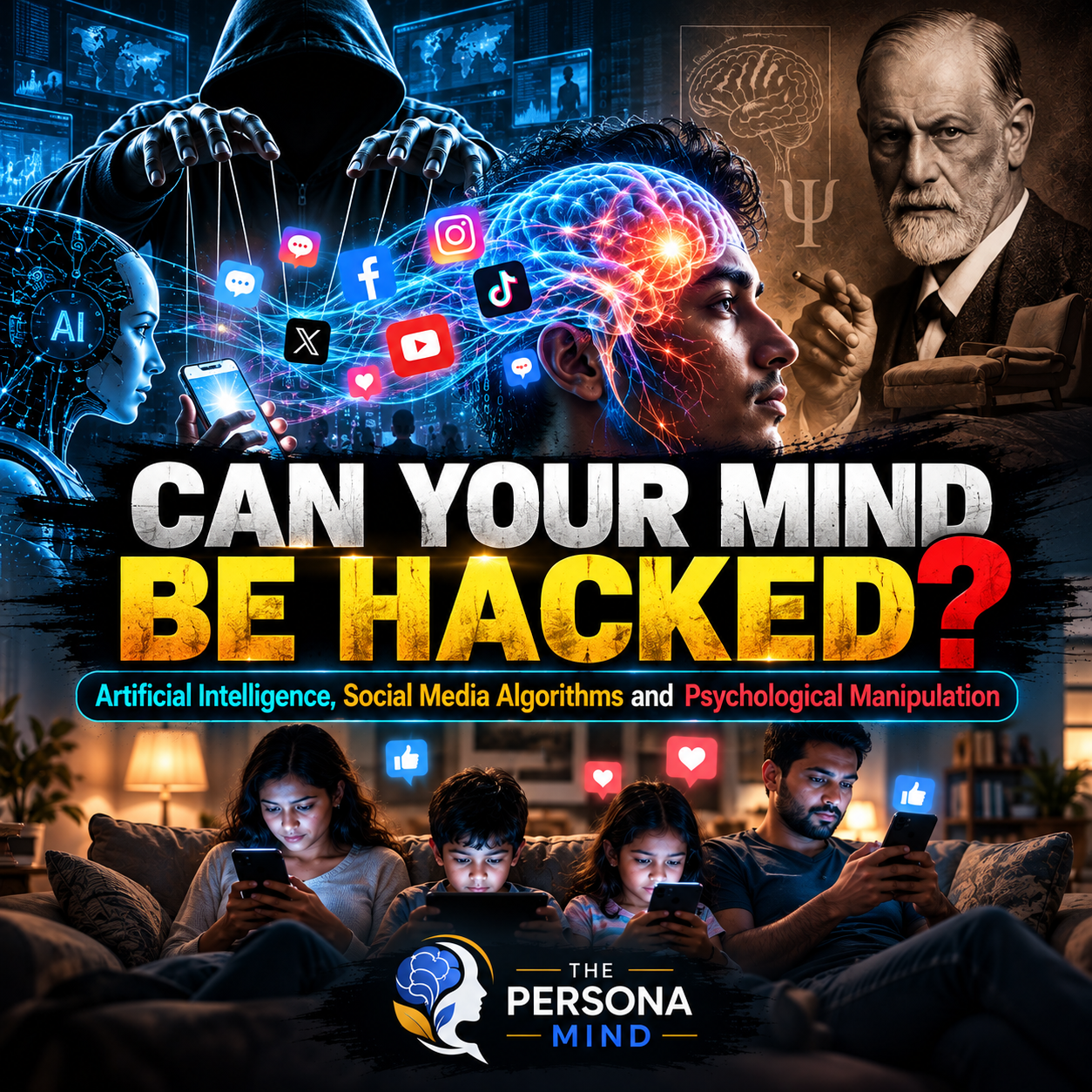
Introduction: Are Your Decisions Really Your Own?
Have you ever wondered how many times you check your smartphone each day?
Have you ever opened Facebook intending to spend just five minutes, only to realize that an entire hour has passed?
Perhaps you have purchased something online that you never planned to buy, simply because an advertisement caught your attention.
These experiences may seem like ordinary parts of modern life. However, behind them lie fascinating psychological processes involving human attention, emotions, habits, and decision-making.
We live in an era where technology does much more than make our lives convenient. Digital platforms can analyze our behavior, predict our interests, recommend content, and influence some of our decisions.
Artificial intelligence, social media algorithms, and behavioral technologies are becoming increasingly sophisticated. They can identify patterns in our digital activities and use those patterns to personalize our online experiences.
This raises an important question:
Can someone influence your mind without directly accessing your brain or even making you aware of that influence?
To understand this question, we must explore the relationship between psychology, neuroscience, information technology, and artificial intelligence.
1. What Is Mind Hacking?
When we hear the word "hacking," we usually think about computers, passwords, cybersecurity, and unauthorized access to digital systems.
A computer hacker may exploit a security weakness to gain access to information or interfere with a system.
But can the human mind be hacked in a similar way?
The human brain is not a computer that can simply be accessed using a password. Ordinary digital technology cannot directly control every thought, emotion, or decision a person makes.
However, human behavior can be influenced through psychological techniques.
In this article, the term mind hacking refers to attempts to influence a person's attention, emotions, beliefs, or decisions by taking advantage of psychological tendencies.
It is important to understand that mind hacking is not a recognized clinical diagnosis or a scientifically established method of directly controlling the brain. It is a metaphor used to describe certain forms of psychological influence and manipulation.
A simple example
Imagine you are shopping online and see the following messages:
- "Only 2 items left in stock!"
- "500 people have already purchased this product!"
- "This special offer expires in 10 minutes!"
You may suddenly feel that you must purchase the product immediately.
Nobody is physically forcing you to buy it. Yet the messages may create a sense of urgency, fear of missing out, or social pressure.
These responses are connected to psychological principles such as the Scarcity Effect, Social Proof, and cognitive biases.
The important distinction is that persuasion is not always harmful. Problems arise when technology uses misleading information, hidden intentions, or deceptive designs to weaken a person's ability to make informed decisions.
2. Do You Control Social Media, or Does Social Media Control Your Attention?
Social media platforms such as Facebook, Instagram, TikTok, and YouTube use recommendation systems to decide which content users are likely to see.
These systems do not necessarily display content randomly.
Instead, they may analyze different behavioral signals, including the videos you watch, the posts you interact with, the topics you search for, and how long you spend viewing certain content.
For example, imagine that you watch several videos about psychology.
The platform may begin recommending more psychology-related videos because your previous behavior suggests that you are interested in that subject.
This can be useful because it helps users discover relevant information.
However, the same technology can also encourage people to spend more time on digital platforms than they originally intended.
The Attention Economy
In the digital world, human attention has become an extremely valuable resource.
Many online businesses generate revenue through advertising, subscriptions, and user engagement.
The longer users remain engaged with a platform, the more opportunities the platform may have to display advertisements or encourage further interaction.
This is closely related to the concept of the Attention Economy.
In an attention-based business model, companies compete to attract and retain users' attention.
As a result, digital platforms may be designed to make content easy to access, interesting, and continuously available.
Features such as endless scrolling, autoplay videos, personalized recommendations, and notifications can encourage repeated engagement.
These features are not automatically harmful. However, they can make it difficult for some users to recognize how much time they are spending online.
The real question is not whether social media has complete control over our minds.
It is whether we are making conscious decisions about how we spend our attention.
3. Dopamine and the Psychology of Digital Rewards
Imagine uploading a photograph to Facebook.
A few minutes later, you check your smartphone.
How many likes have you received?
Has anyone commented?
Did the person you expected to respond react to your post?
These behaviors involve psychological processes related to social approval, expectations, rewards, and learning.
One important biological component is dopamine.
What is dopamine?
Dopamine is a neurotransmitter, a chemical messenger involved in communication between nerve cells.
It plays important roles in motivation, learning, movement, and reward-related processes.
Dopamine is often described as the brain's "pleasure chemical," but this explanation is overly simplistic.
Its functions are more complex and include helping the brain learn about expected and unexpected outcomes.
For example, receiving an unexpected positive response may contribute to reward-related learning.
Digital platforms provide frequent opportunities for new information, social interaction, and unexpected feedback.
Notifications, comments, likes, and new content may encourage users to return repeatedly.
Over time, checking a smartphone can become a habit.
Does this mean everyone is addicted to social media?
No.
Frequently checking a smartphone does not automatically mean that a person has an addiction.
Smartphone use can be influenced by many factors, including work responsibilities, social relationships, boredom, curiosity, habits, and emotional needs.
A more meaningful concern is whether digital behavior interferes with important areas of life.
For example, excessive or poorly controlled use may affect sleep, academic performance, work responsibilities, or personal relationships.
Understanding these patterns can help people develop healthier digital habits.
4. Can Artificial Intelligence Know You Better Than You Know Yourself?
Artificial intelligence has significantly improved the ability of computer systems to analyze large amounts of information.
When people use digital platforms, they may generate behavioral data through their searches, clicks, purchases, viewing habits, and interactions.
Machine learning systems can analyze patterns in these activities.
For example, someone who frequently searches for holiday destinations may receive advertisements for hotels, airlines, or travel packages.
A person who watches technology reviews may receive recommendations for smartphones, laptops, or other electronic devices.
This process is related to Behavioral Profiling.
Behavioral profiling involves using available information to identify patterns, interests, or characteristics associated with individuals or groups.
Predictive analytics
Artificial intelligence can also use predictive analytics to estimate the probability of certain future behaviors.
For example, a shopping platform may estimate which products a customer is more likely to purchase.
A streaming service may predict which movie a user is likely to enjoy.
A social media platform may estimate which videos are likely to attract a user's attention.
However, an important scientific limitation must be recognized.
Predicting behavior is not the same as reading someone's mind.
If a person watches a particular video several times, an algorithm may interpret this as interest.
But the person may actually be watching it for research, criticism, or another reason.
Behavioral data cannot always reveal the true motivations behind human actions.
AI systems can identify statistical patterns, but they can also make incorrect predictions.
Therefore, claims that artificial intelligence can perfectly understand someone's thoughts or personality should be treated with caution.
5. Are Your Decisions Really Your Own?
Human beings do not always make decisions through completely logical reasoning.
Our choices are influenced by emotions, past experiences, social expectations, habits, and mental shortcuts.
Psychologists call some of these mental shortcuts heuristics.
Heuristics help people make decisions quickly without analyzing every available piece of information.
Although they are often useful, they can sometimes lead to predictable errors in judgment.
The Anchoring Effect
Imagine visiting an online store and seeing a product advertised as follows:
Original price: Rs. 15,000
Discounted price: Rs. 7,500
You may immediately feel that the product is an excellent bargain.
However, you might not know whether the original price accurately reflects its normal market value.
The first price may influence how you evaluate the second price.
This is an example of the Anchoring Effect.
The initial information becomes a reference point for later judgments.
Dark Patterns in digital design
Another important concept is Dark Patterns, also known as deceptive design patterns.
These are interface designs that mislead or pressure users into making choices they might not otherwise make.
For example, a website may automatically select an additional paid service during checkout.
A user who does not notice the selected option may unintentionally agree to an additional charge.
Other examples include confusing cancellation procedures, misleading buttons, and hidden subscription conditions.
The Fogg Behavior Model
Behavior researcher B. J. Fogg proposed a model explaining how behavior occurs when three elements come together:
- Motivation — the person wants to perform an action.
- Ability — the action is sufficiently easy to perform.
- Prompt — something encourages the person to act at that moment.
This model helps explain how technology can influence behavior through design.
However, the same principles can also be used positively.
For example, reminder applications can encourage people to take prescribed medication, exercise, or complete educational activities.
Therefore, behavior-influencing technology is not automatically unethical.
The important questions concern transparency, intention, consent, and the user's freedom to choose.
6. Why Can Repeated False Information Begin to Feel True?
Imagine seeing a news story on social media.
Initially, you are uncertain whether it is true.
The following day, you see the same claim on another page.
Later, several people share similar posts.
Eventually, the information may begin to feel familiar and believable.
This phenomenon is related to the Illusory Truth Effect.
The Illusory Truth Effect
In 1977, researchers Lynn Hasher, David Goldstein, and Thomas Toppino investigated how repetition influences judgments of truth.
Their research demonstrated that repeated exposure to statements can increase people's ratings of their truthfulness.
The important point is that repetition does not make a statement factually correct.
Instead, repeated information may become easier to process and more familiar.
That familiarity can sometimes be mistaken for evidence of truth.
This has important implications for social media misinformation.
False claims about health, science, economics, or social issues may become more believable when repeatedly circulated.
However, the effect is not universal. Prior knowledge, careful reasoning, and access to reliable evidence can influence whether people accept a claim.
Information does not become true simply because we see it repeatedly.
This is why verifying information before sharing it is an essential digital skill.
7. Echo Chambers: Are You Seeing Only the World You Want to See?
Imagine that you strongly believe in a particular idea.
You follow social media pages that support your opinion.
You interact with people who share similar beliefs.
You frequently read articles that confirm what you already think.
Over time, you may encounter more information supporting your existing position than information challenging it.
This environment is commonly described as an Echo Chamber.
An echo chamber is a social or informational environment where similar views are repeatedly reinforced.
Confirmation Bias
A related psychological concept is Confirmation Bias.
Confirmation bias refers to the tendency to seek, interpret, or remember information in ways that support existing beliefs.
For example, a person who believes that a particular technology is dangerous may pay more attention to reports describing its risks.
The same person may ignore reliable evidence showing its benefits.
Digital recommendation systems can sometimes contribute to selective exposure by recommending content similar to what users previously engaged with.
However, algorithms do not always show people only content they agree with.
Users may also encounter opposing opinions, controversial material, and diverse viewpoints.
Echo chambers develop through a combination of personal choices, social relationships, information sources, and platform design.
To reduce the influence of confirmation bias, people should actively consider credible alternative explanations and evidence.
Critical thinking does not require accepting every opinion as equally valid.
It requires evaluating claims according to the quality of the evidence supporting them.
8. Social Engineering: When Cybercriminals Target Human Psychology
Cybersecurity is not only about protecting computers and networks.
It is also about understanding human behavior.
Consider the following situation.
You receive a WhatsApp message claiming to be from your bank.
The message states that your account will be suspended unless you immediately verify your identity.
A link is provided.
You become worried and consider clicking it without checking whether the message is genuine.
This is a common example of Social Engineering.
Social engineering involves manipulating people into revealing information or performing actions that compromise security.
Cybercriminals may exploit psychological factors such as fear, urgency, curiosity, trust, and respect for authority.
Common social engineering techniques
Phishing involves fraudulent messages designed to obtain sensitive information or direct users to malicious websites.
Impersonation involves pretending to be a trusted person or organization.
Fear-based manipulation creates a sense of immediate danger to encourage quick decisions.
Reward-based manipulation promises prizes, financial benefits, or special opportunities to encourage cooperation.
In Sri Lanka, examples may include fraudulent banking messages, fake job advertisements, suspicious investment offers, and attempts to obtain one-time passwords.
Even individuals with technical knowledge can become vulnerable when they are distracted, frightened, or under pressure.
Therefore, cybersecurity awareness should include both technical knowledge and psychological understanding.
Users should avoid sharing passwords or OTPs and verify suspicious requests through official channels.
9. Why Do People Develop Emotional Connections With AI Chatbots?
Artificial intelligence is increasingly becoming part of everyday communication.
People use AI chatbots to ask questions, solve problems, organize ideas, study, and discuss personal concerns.
Some users may also develop emotional attachments to conversational AI systems.
Why does this happen?
One explanation involves Anthropomorphism.
Anthropomorphism is the tendency to attribute human characteristics, emotions, or intentions to non-human entities.
When an AI chatbot communicates in a friendly and supportive manner, users may experience its responses as personal or emotionally meaningful.
For example, someone experiencing loneliness may feel comfortable discussing personal concerns with an AI system.
The system may provide information, help organize thoughts, or respond using emotionally supportive language.
However, generating human-like responses is not the same as experiencing emotions in the way humans do.
The psychological risks of excessive dependence
AI tools can provide useful support, but excessive dependence may create problems.
A person may begin relying on an AI system for every important decision.
Another person may place too much confidence in responses that contain errors.
This is related to Automation Bias, the tendency to give excessive weight to information or recommendations produced by automated systems.
AI can assist with learning, reflection, and access to information.
However, it should not replace independent judgment, meaningful human relationships, or appropriate professional mental health care.
This distinction is particularly important when discussing serious psychological difficulties.
10. What Does Scientific Research Tell Us?
Scientific research provides useful evidence about the relationship between attention, technology, and human decision-making.
However, research findings must be interpreted carefully.
A study demonstrating an effect under particular conditions does not necessarily mean that the same effect occurs for every person in every situation.
Research on smartphone presence
In 2017, Adrian Ward and colleagues published a study titled Brain Drain: The Mere Presence of One's Own Smartphone Reduces Available Cognitive Capacity.
The researchers investigated whether the presence of a smartphone could influence performance on certain cognitive tasks.
Participants completed cognitive tests under different conditions, including situations where their phones were placed nearby or in another room.
The researchers reported that participants performed better on some measures when their phones were located in another room rather than on their desks.
The findings suggested that the presence of a smartphone might consume some attentional resources even when the device is not actively being used.
However, the study does not establish that smartphones always reduce intelligence or cognitive ability.
Its findings relate to particular tasks, experimental conditions, and participant groups.
Research on repeated information
Hasher and colleagues' 1977 study demonstrated that repetition can influence judgments of truth.
This research helps explain why repeated misinformation may become more believable.
Research on persuasive technology
B. J. Fogg's work on persuasive technology examines how interactive systems can be designed to influence attitudes and behavior.
His behavior model provides a useful framework for understanding how motivation, ability, and prompts contribute to action.
Research on decision-making
Psychologists Daniel Kahneman and Amos Tversky made important contributions to understanding judgment under uncertainty, heuristics, and cognitive biases.
Their work helps explain why people sometimes make decisions that differ from what a purely rational analysis might predict.
Together, these areas of research demonstrate that human attention and decision-making are influenced by psychological and environmental factors.
They do not demonstrate that digital technology can completely control the human mind.
11. How Can You Protect Your Mind From Digital Manipulation?
Avoiding technology completely is neither realistic nor necessary.
Technology provides valuable opportunities for education, communication, employment, healthcare, and personal development.
The better approach is to develop awareness and use digital tools responsibly.
Develop digital literacy
Digital literacy involves more than knowing how to operate a smartphone or computer.
It includes the ability to evaluate online information, understand digital risks, protect personal data, and recognize misleading content.
A digitally literate person should be able to question the credibility of information rather than accepting it automatically.
Manage unnecessary notifications
Frequent notifications can interrupt concentration.
Disabling non-essential notifications may help reduce unnecessary distractions.
Verify information before sharing
Before sharing a news story, examine its source.
Look for confirmation from reliable organizations.
Be cautious about emotionally charged headlines that encourage immediate reactions.
Avoid impulsive online purchases
When an advertisement creates urgency, consider whether the product is genuinely necessary.
Compare prices and evaluate the information before making a decision.
Protect personal information
Review application permissions, privacy settings, and account security.
Avoid sharing sensitive information through suspicious links or messages.
Create technology-free periods
Set aside time for activities that do not require a smartphone.
Reading, exercise, family conversations, and focused study can provide opportunities to direct attention toward other meaningful activities.
Practice self-regulation
Self-regulation refers to the ability to monitor and manage thoughts, emotions, and behavior in ways that support personal goals.
For example, before opening a social media application, ask yourself:
"Why am I using my phone right now?"
If you cannot identify a clear purpose, you may be responding to a habit rather than making a conscious choice.
Small moments of awareness can help people become more intentional about their digital behavior.
12. Who Will Protect the Freedom of the Human Mind in the Future?
As artificial intelligence and neuroscience develop, new ethical questions are emerging.
Traditionally, digital privacy discussions have focused on protecting personal information such as names, addresses, financial records, and communication data.
However, emerging technologies are creating new concerns about behavioral information, cognitive processes, and neural data.
One important development is Brain–Computer Interface technology.
Brain–computer interfaces are systems designed to connect certain patterns of brain activity with computers or external devices.
Such technologies may help people with severe physical disabilities communicate or control assistive devices.
However, they also raise important questions about privacy, consent, data protection, and human autonomy.
Mental Privacy
Mental privacy concerns the protection of information related to an individual's mental processes.
As technologies capable of recording or interpreting certain neural signals improve, protecting neural data may become increasingly important.
Cognitive Liberty
Cognitive liberty refers to the idea that individuals should have freedom over their own mental processes and cognitive autonomy.
It is closely connected to discussions about human rights, informed consent, and emerging neurotechnologies.
These concepts are becoming increasingly relevant in discussions of AI ethics and neuroethics.
The challenge is not simply to prevent technological development.
Instead, society must consider how technology can be developed and used while respecting human dignity, privacy, and independent decision-making.
Governments, researchers, technology companies, and users all have responsibilities in this process.
Conclusion: Who Really Controls Your Mind?
Let us return to our original question.
Can your mind be hacked without you knowing?
The answer depends on what we mean by hacking.
Ordinary digital technology cannot access the human mind like a computer system and take complete control of a person's thoughts.
However, psychological principles and digital technologies can influence attention, emotions, beliefs, and decisions.
Social media algorithms can influence the information we encounter.
Advertisements can influence our purchasing decisions.
Repeated information can affect our judgments of truth.
AI systems can predict certain behavioral patterns.
Deceptive digital designs can encourage actions that users may not have intended.
Understanding these influences is an important part of living in a digital society.
Technology itself is not necessarily the enemy.
Artificial intelligence, social media, and information technology can provide enormous benefits when used responsibly.
The challenge is to recognize when these tools support our goals and when they may redirect our attention or influence our decisions in ways we do not fully understand.
We cannot eliminate every psychological influence from our lives.
But we can become more aware of those influences, evaluate information critically, and make more deliberate choices.
Remember:
Technology may not be able to completely control your mind, but it can influence your decisions without you fully realizing it.
Recognizing those influences is the first step toward protecting your freedom to think independently.
References
1. Hasher, L., Goldstein, D., & Toppino, T. (1977). Frequency and the conference of referential validity. Journal of Verbal Learning and Verbal Behavior, 16(1), 107–112. https://doi.org/10.1016/S0022-5371(77)80012-1
2. Ward, A. F., Duke, K., Gneezy, A., & Bos, M. W. (2017). Brain drain: The mere presence of one's own smartphone reduces available cognitive capacity. Journal of the Association for Consumer Research, 2(2), 140–154. https://doi.org/10.1086/691462
3. Fogg, B. J. (2009). A behavior model for persuasive design. Proceedings of the 4th International Conference on Persuasive Technology. https://doi.org/10.1145/1541948.1541999
4. Fogg, B. J. (2003). Persuasive Technology: Using Computers to Change What We Think and Do. Morgan Kaufmann.
5. Kahneman, D. (2011). Thinking, Fast and Slow. Farrar, Straus and Giroux.
6. Tversky, A., & Kahneman, D. (1974). Judgment under uncertainty: Heuristics and biases. Science, 185(4157), 1124–1131. https://doi.org/10.1126/science.185.4157.1124